
Where to Stay in Tokyo: Best Areas for First-Timers (With Map)
Where to stay in Tokyo for the first time: compare Shinjuku, Shibuya, Asakusa, Ginza, Ueno and more by vibe, transport and price on an interactive map.

Explore Tokyo districts
Shinjuku 新宿
Tokyo's busiest district: neon-lit entertainment alleys, calm gardens, giant department stores and one of the world's largest stations.
Best for: Nightlife, Gardens, City views, Dining
Select a place with the keyboard
Tokyo's best areas to stay, compared
These price levels are relative editorial bands, not rates or a promise about every hotel. Use them to narrow a shortlist, then compare your dates, party size and cancellation terms. Transport names were checked against the official operator maps; the table does not promise journey times.
| Area | Vibe | Transport | Price level | Best for | Hotels |
|---|---|---|---|---|---|
| Shinjuku | Busy, varied and bright after dark | Shinjuku: JR Yamanote and Chuo; Marunouchi subway. Shinjuku-sanchome: Fukutoshin. | $$–$$$ | Varied first trips and dining | Compare Shinjuku hotels |
| Shibuya | Youthful shopping and evening energy | Shibuya: JR Yamanote; Ginza, Hanzomon and Fukutoshin subway lines. | $$–$$$ | Shopping, couples and nightlife | Compare Shibuya hotels |
| Asakusa | Temple streets and river walks | Asakusa: Ginza and Toei Asakusa lines. Tawaramachi: Ginza Line. | $–$$ | Old Tokyo and value-minded stays | Compare Asakusa hotels |
| Ginza | Polished shopping, dining and theater | Ginza: Ginza, Marunouchi and Hibiya lines. Yurakucho: JR Yamanote. | $$$–$$$$ | Luxury shopping and dining | Compare Ginza hotels |
| Ueno | Museums, park paths and market streets | Ueno: JR Yamanote; Ginza and Hibiya lines. Keisei-Ueno: Skyliner. | $–$$ | Museums, families and budgets | Compare Ueno hotels |
| Akihabara | Electronics, anime, games and arcades | Akihabara: JR Yamanote and Chuo-Sobu; Hibiya Line. Suehirocho: Ginza Line. | $$ | Games, electronics and focused shopping | Compare Akihabara hotels |
| Minato | Tower landmarks and varied station areas | Kamiyacho and Roppongi: Hibiya Line. Akabanebashi and Roppongi: Oedo Line. | $$$–$$$$ | Tower views and a specific hotel choice | Compare Minato hotels |
Best area to stay in Tokyo for first-timers
Start with Shinjuku if your plan includes different sides of the city and you want a flexible evening base. It is a practical default, not a universal winner. If a crowded station makes you anxious or quiet surroundings are central to your trip, a carefully chosen hotel elsewhere may suit you better. Shibuya is the next option when shopping, the crossing and evening atmosphere are the main draw. Asakusa is our alternative for travelers who prioritize temple streets and old Tokyo.
A hotel near a JR Yamanote Line station is a useful first filter because the loop connects several districts in this guide. It should not become a rule that overrides your actual itinerary. Ginza's subway connections and Asakusa's Ginza Line access may fit your daily plans better. Look at the first and last journey of each day, then choose the address that makes those journeys comfortable.
Shinjuku
Shinjuku is our default recommendation when a first trip mixes sightseeing, restaurants and evenings out. It gives you several different versions of Tokyo within the same planning area: a garden day, a city-view stop, department-store browsing and compact dining streets. You can choose a hotel to suit the part of the district you actually want to return to, rather than treating every address with Shinjuku in its name as equivalent.
The tradeoff is orientation. The station and its surroundings require attention to exits, and a hotel beyond a confusing crossing can feel less convenient than its map distance suggests. Compare the actual walk from your intended platform or exit, especially with luggage. Travelers looking for quiet streets immediately outside the lobby should check the exact address and recent noise comments rather than assuming a district-wide experience.
Shinjuku Station serves the JR Yamanote and Chuo lines, while the Marunouchi Line and nearby Shinjuku-sanchome add subway options. Our hotel price band is an editorial guide to relative positioning, not a quoted nightly rate. Check your dates and room occupancy before deciding whether a particular stay is good value.
Nearby highlights
Shibuya
Choose Shibuya if the crossing, fashion stores and an evening skyline view sound like the Tokyo you want outside your hotel. It suits visitors who enjoy returning to a busy neighborhood after sightseeing rather than ending the day in a quiet residential setting. A central base makes it easier to put shopping and a booked observation-deck visit into the same day, with time to change plans if the weather or your energy changes.
The downside is that the most appealing central locations can also be noisy and crowded. A room's floor, window orientation and immediate street matter more than a broad neighborhood label. If nightlife is a reason to choose Shibuya, still check how you will get back to the hotel on foot; if nightlife is something to avoid, look for a room and street that support that preference.
JR's Yamanote Line serves Shibuya, and the Ginza, Hanzomon and Fukutoshin subway lines provide other options. Pick the entrance that suits the lines you will use. Meiji Shrine and Yoyogi Park belong to the wider sightseeing area in our guide, but their presence in a Shibuya itinerary does not mean they are outside your station-side hotel.
Nearby highlights
Asakusa
Asakusa is a strong choice if your idea of a good morning involves temple streets and a river walk. It lets old Tokyo shape the daily rhythm of your trip rather than becoming a single stop squeezed between western shopping districts. We include it among the value-minded options, but that is a relative editorial comparison: the room you want on your dates may cost more than a deal elsewhere. Always compare actual totals.
The main compromise is where your other plans lie. Repeated evenings in Shibuya or Shinjuku can make a western base more natural. Asakusa is not a JR Yamanote Line stop; the Ginza and Toei Asakusa lines are useful instead. Do not reject it solely for being off the loop, but sketch your likely journeys before committing to a stay.
Check which Asakusa station entrance a hotel means, as different operators and entrances are not interchangeable. Tawaramachi on the Ginza Line is another address reference worth checking. Our sightseeing group also includes Tokyo Skytree across the river in Sumida ward; that grouping connects a practical day out and does not turn Skytree into a landmark inside Taito ward.
Nearby highlights
Ginza
Ginza is our recommendation for travelers who want an upscale shopping and dining base. Its appeal is less about checking off one landmark and more about having stores, restaurants and theater interests shape the area you return to. That can work well for couples who enjoy browsing without making every evening a separate expedition. Compare the quieter side streets with the busiest shopping approaches when you review a specific hotel.
Expect the relative price positioning to lean higher, while remembering that this guide does not quote rates. A compact room with a famous district name is not necessarily better value than a larger room elsewhere. Decide whether the local atmosphere is something you will use each day, or simply a place you could visit while staying in another area.
Ginza has the Ginza, Marunouchi and Hibiya subway lines; nearby Yurakucho brings JR Yamanote access. Tokyo Station and Marunouchi can be paired with Ginza sightseeing, but they are distinct station and street areas. If onward rail travel drives your choice, check the actual hotel approach to Tokyo Station instead of relying on a general Ginza location label.
Nearby highlights
Ueno
Ueno makes sense when museums and park time are important parts of your trip. You can organize sightseeing around the park and leave room for market browsing instead of crossing the city before the day has properly begun. Families may appreciate having several different kinds of stop in the same planning area, while visitors comparing hotel costs should include Ueno alongside Asakusa in their shortlist. Neither district guarantees the cheapest room on a particular date.
Look closely at which side of the station you will use. A hotel described as near Ueno may fit the market side better than the museum approach, and the best choice depends on your plans. Check the room setup, elevators and the actual pedestrian route with luggage. A convenient arrival does not remove the need to inspect the building and street.
Ueno connects to JR Yamanote and the Ginza and Hibiya subway lines. Keisei-Ueno is the city-end reference for the Skyliner from Narita Airport. These names describe transport options, not promised journey times or a through service for every destination. Follow the operator's current route and station instructions before booking your arrival travel.
Nearby highlights
Akihabara
Akihabara suits travelers who want electronics, anime, games and arcades to be part of the area they return to. It is a focused choice rather than our default for every first visit. If browsing specialist stores is a real priority, staying nearby gives you flexibility to revisit a shop or separate shopping from other sightseeing. If it is only one stop on a broader trip, weigh the hotel itself and transport against the neighborhood theme.
The evening atmosphere is different from choosing a nightlife-first district. Do not assume that the stores you want will match your arrival or late-evening plans; check individual opening details before organizing a shopping day. A location marketed as Akihabara may also be more useful for a nearby station than for the particular streets you expect to visit.
Akihabara Station offers JR Yamanote and Chuo-Sobu services plus the Hibiya Line, while Suehirocho gives Ginza Line access. Our Electric Town center is in Chiyoda, with neighborhood usage extending beyond a neat administrative box. Select the hotel by its street and nearest useful entrance, then check the rest of your daily journeys.
Nearby highlights
Minato (Tokyo Tower & Roppongi area)
Minato needs the most careful reading of a hotel address because it is a broad administrative ward, not one compact station neighborhood. Our sightseeing group is anchored by Tokyo Tower and Zojo-ji, while a stay described through Roppongi can serve a different daily plan. Choose the exact station and street before comparing rooms. The ward name alone cannot tell you whether you will walk to the attraction or make a separate journey.
This can work well if you have a particular hotel in mind or want Tokyo Tower to frame part of your stay. It is less useful as a blanket first-timer recommendation when your plans are spread across the other six areas. Compare the hotel approach, local dining options and your return journey after an evening out rather than choosing a broad district reputation.
Kamiyacho and Roppongi are Hibiya Line references; Akabanebashi and Roppongi are Oedo Line references. Which station is best depends on the actual building and entrance. Our relative price band describes the guide's positioning, not all hotels in the ward. Check your dates and the room's final booking terms alongside that location choice.
Nearby highlights
Where to stay by travel style
With kids & families
Ueno and Asakusa can fit park, museum and temple plans without making every day begin with a distant sightseeing goal. Prioritize room capacity, elevators and the practical walk with a stroller. A calmer hotel street may be more useful than sleeping directly beside the busiest station entrance.
See Ueno hotel-area adviceNightlife
Choose Shibuya or Shinjuku if you want evening activity to be close to your base. Check the walk back and whether room reviews mention noise. Plan a return route before going out rather than assuming trains will match any finishing time.
See Shibuya hotel-area adviceBudget
Compare Ueno and Asakusa first, then include any well-connected hotel that meets your needs. Compare the full stay total, not a headline starting rate. A room that needs costly extra journeys or does not fit your group may be poor value despite a lower price.
See Asakusa hotel-area adviceLuxury
Ginza and selected Minato addresses suit travelers who prioritize an upscale hotel and dining setting. Choose the specific property, room and service you want rather than expecting a neighborhood label to guarantee quality. Check how often your sightseeing plan will use that location.
See Ginza hotel-area adviceCouples
Shibuya works for shared shopping and skyline interests, while Ginza can suit dining-led evenings. Discuss whether you prefer a busy return to the hotel or a calmer street. Matching the daily rhythm of both travelers is more useful than chasing a district described as romantic.
See Shibuya hotel-area adviceShopping
Choose Shibuya for fashion-oriented browsing, Ginza for upscale stores or Akihabara for games and electronics. Staying nearby is most useful when you expect repeat visits or want to drop bags at the hotel. Check the individual shops you care about before choosing a base around them.
See Akihabara hotel-area adviceNear a train station
Identify the operator, entrance and platform approach that your trip will use. A station name in a hotel listing is only a starting point. Compare the pedestrian route with luggage and check accessible entrances rather than treating a short straight line on a map as a complete journey.
See Shinjuku hotel-area adviceShibuya or Shinjuku?
Choose Shinjuku when your plan combines several kinds of sightseeing and you want a broad dining and transport base. Choose Shibuya when shopping, the crossing and evenings out are the main reason for your Tokyo stay. Both can be crowded, so the more useful comparison often happens at hotel-street level: which entrance will you use, how will you return at night, and does the room fit your group? Neither district wins every itinerary. Compare the two areas in detail before booking, then use the map to see which one fits your planned stops.
Shibuya vs Shinjuku: compare the two hotel basesPractical tips for choosing a hotel area
Check a hotel's published street address against your planned station exit, then review the pedestrian route. Large stations may have a useful entrance on a different side from the hotel's advertised reference point. With bulky luggage, elevators and crossings matter. Ask the property about luggage storage if your arrival or departure falls outside check-in times; do not assume that every hotel provides the same service.
For Narita arrivals, compare the official Narita Express and Keisei Skyliner routes with your hotel station. For Haneda, consult the airport's current ground-transport instructions before choosing a transfer. We do not quote airport journey times here. Book when you find a location, room setup and terms that fit your plan; compare refundable and prepaid options without assuming that one booking window always delivers the lowest rate.
See every district on the Tokyo neighborhoods map
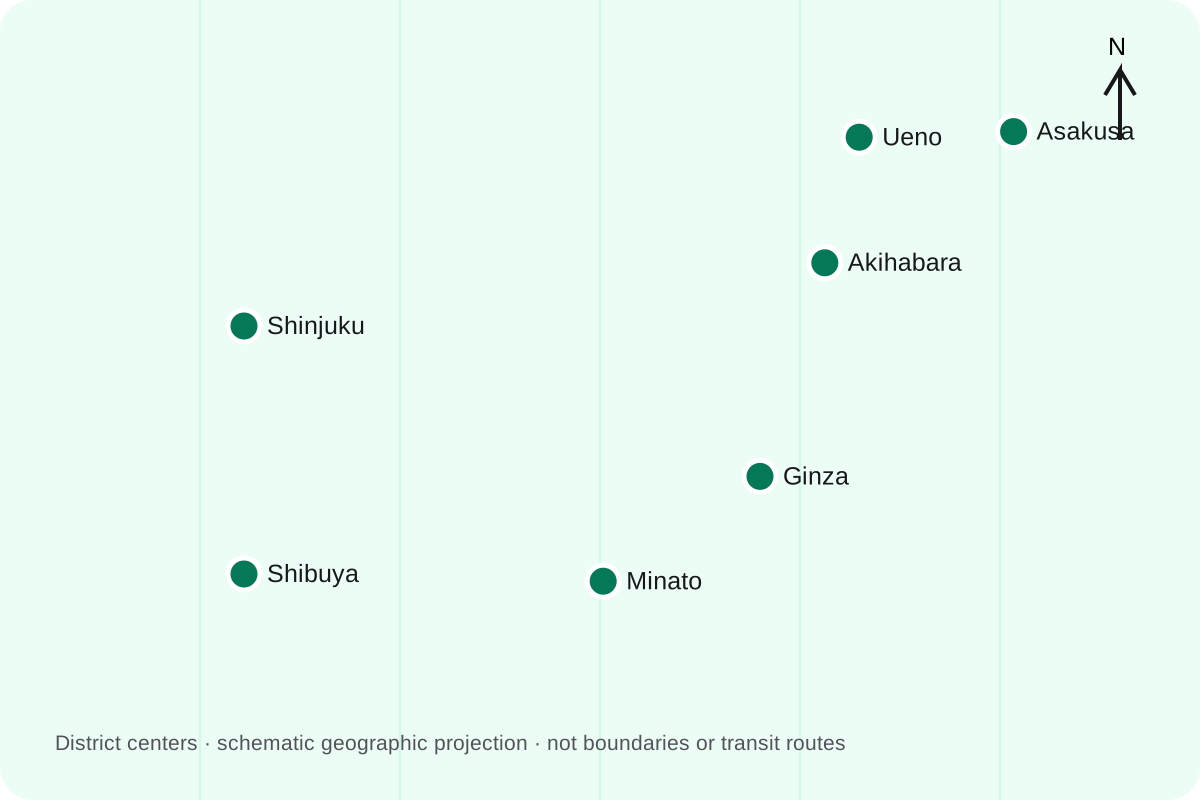
Use the full district guide to separate travel neighborhoods from administrative wards, group your sightseeing and see all of the places in this Tokyo pack. The original diagram is also available as a printable SVG.
Frequently asked questions
Where is the best area to stay in Tokyo for first-timers?
Shinjuku is our all-round recommendation for varied sightseeing and dining. Choose Shibuya for shopping and evenings out, or Asakusa when temple streets and old Tokyo matter more. The exact hotel address and station entrance can matter as much as the district.
Is Shinjuku or Shibuya better to stay in?
Choose Shinjuku for a broader mix of dining, gardens and rail-connected plans. Choose Shibuya when fashion, the crossing and evening city views are priorities. Both are busy; check the hotel street, room setup and noise comments before booking.
What is the cheapest area to stay in Tokyo?
Include Ueno and Asakusa in a value-minded shortlist, then compare your actual dates. No district guarantees the lowest nightly rate. Room size, occupancy, cancellation terms and major events can change which option is best value.
Where should families stay in Tokyo?
Ueno can suit museum and park days, while Asakusa works for temple-focused plans. A quieter hotel street in Shinjuku can also work. Choose family room capacity, access to elevators and the walk with luggage before a neighborhood reputation.
Is it better to stay near a JR Yamanote Line station?
It is a useful starting rule for a mixed sightseeing trip, since the loop connects several areas in this guide. A subway-side hotel can fit your itinerary better, especially in Asakusa or Ginza. Compare the actual journeys you expect to make.
How many nights should I spend in one area?
For a short Tokyo visit, one base usually keeps packing and check-in work down. Consider changing hotels only when a different location solves a clear travel need. Group sightseeing by area so you can keep one room without repeating unnecessary cross-city trips.
Some links on this page are affiliate links. If you book through them, PlayableTrip may earn a small commission at no extra cost to you. How we make money.
Find a Tokyo airport pickup
Choose your Tokyo airport, arrival details and hotel address to compare a private pickup.
Check Tokyo transfers on Welcome PickupsCompare Narita Airport to Tokyo transfers
This form is prefilled for Narita Airport to Tokyo. The direct Haneda link above is a separate route.
Check Haneda transfers on KiwitaxiSource & review
Last verified October 6, 2026. Hours, prices, access and closures can change. Check the operator’s site before your visit.