
Tokyo in December
Plan Tokyo in December: typical weather, winter illuminations, Christmas and New Year closures, packing, and evening light-up spots on a 3D map.
December weather and what to pack
The Japan Meteorological Agency’s 1991–2020 normals for Tokyo put December’s mean temperature at 7.7°C. The agency’s monthly table for the Tokyo observation (the same station used in those normals) lists a mean daily maximum of 12.0°C and a mean daily minimum of 3.8°C. Average relative humidity is 56 percent. Sunshine duration for the month is 174.4 hours. Precipitation for December is 57.9 mm. The monthly snowfall-depth columns on that table are 0, and the snow-day figure is 0.6. These are 30-year averages, not a forecast for the week you land. A single cold front can sit below the minimum, and a mild week can feel closer to November.
Pack for that range, not for a ski town. A coat you can wear at 4°C in the evening, a layer you can take off when the afternoon reaches the low teens, and shoes that handle damp pavement are the useful kit. An umbrella belongs in the bag because 57.9 mm across the month is not a dry month, even though it is far below Tokyo’s summer totals. Gloves matter more for a night of standing at an illumination than for walking between heated stations. You do not need heavy snow boots on the strength of the normals: the same table does not show a December snowpack in central Tokyo. If a forecast the week you travel shows snow, believe the forecast over the normal.
The numbers are city-center normals. Hakone, Nikko, and the Fuji lakes are colder than the Tokyo station these figures describe. A day trip in December needs another layer on top of what feels fine in Ginza. Wind on an open observation deck is also outside the street-level number. Shibuya Sky’s rooftop is outdoors; Skytree’s decks are indoors. Dress for the deck you actually booked.
Winter illuminations
Checked Oct 11, 2026. GO TOKYO’s winter illumination guide was updated on January 1, 2026 and describes the season that had already started, not a calendar for December 2026. Use it as the official index, then open the event page for the year you are visiting. This article does not invent switch-on dates for the coming winter.
What GO TOKYO has published, and marked as already over, is still useful as a map of which organizers run lights. Marunouchi Illuminations 2025 ran from November 13, 2025 to February 15, 2026, with lights listed at 16:00–23:00 and, in December, 16:00–24:00 in some stretches. The page says the display used the area around Marunouchi Naka-dori and, in some periods, Gyoko-dori. Tokyo Station’s Marunouchi south exit is the access note on that page, about a one-minute walk. Price listed: free. Tokyo Dome City’s “TOKYO SNOW DOME CITY” ran from November 17, 2025 to March 1, 2026, with hours listed at 17:00–24:00, subject to sunset and event changes, and a free admission line. GO TOKYO lists Suidobashi Station at about 3 minutes on foot and Korakuen Station at about 3 minutes. Tokyo Illumilia 2025–2026, around Yaesu and Nihonbashi, ran from November 6, 2025 to February 14, 2026, with lights listed at 16:30–23:30.
Those three are examples of how Tokyo publishes a season: a date range, a clock time, a station, and a note that the next year can differ. Ginza, Omotesando, and Roppongi Midtown appear in GO TOKYO’s winter writing as areas where lights usually go up. They are not, on the pages reviewed on October 11, 2026, a confirmed December 2026 schedule. If a hotel or a blog still shows last winter’s poster, treat it as last winter.
A practical December evening is one neighborhood of lights plus one dinner, not four displays. Marunouchi and Ginza share a walk from Tokyo Station. Shibuya is a different train. Tokyo Dome City is a third. Pick one cluster so you are outside while the lights are actually on, which on the published 2025–26 pages meant late afternoon into the evening, not midnight.
GO TOKYO illumination guideMarunouchi 2025 pageTokyo Dome City 2025–26 pageTokyo StationGinza Crossing
Christmas in Tokyo
December 25 is not the Japanese New Year, and it is not a day when the city shuts the way it does on January 1. Shops, trains, and restaurants largely run. Illuminations and commercial decorations are the public face of Christmas. Fried chicken and strawberry shortcake are the meal many families book ahead; that is a reservation habit, not a law, and a restaurant that has not taken a booking can still be open for something else. If a specific dinner is the point, reserve it. If it is not, eat wherever is open and spend the evening on lights.
Couples and shopping districts lean into the date more than temples do. Ginza, Marunouchi, and the area around Tokyo Station are the straightforward Christmas walk because the illuminations, when scheduled, sit on streets you were going to use anyway. Shrines are not decorated as Christmas churches. If you want a religious Christmas service, look up the church you have in mind; this guide does not list one we did not verify.
The crowded version of the holiday is the weekend nearest the 25th, plus Christmas Eve evening. A weekday afternoon in the first half of December is when the lights may already be on and the sidewalks are still usable. Confirm the switch-on date on the organizer’s page before you fly in on December 1 expecting every street to be lit.
What closes from December 29 to January 3
There is no single citywide shutdown, and there is no single citywide opening. Each museum, garden, shop, and restaurant posts its own calendar. The useful move is to check the two or three places your itinerary actually names, instead of assuming “everything closes” or “everything stays open.”
Tokyo National Museum has published a specific 2026 year-end. It is open through December 25. From December 22 through December 25, only the Horyu-ji Treasures Gallery and the Kuroda Memorial Hall are open. The museum is closed from December 26 through December 31, 2026. January 1, 2027 is listed as open, with hours not yet determined when that page was written. December 15, 2026 is a separate facility-inspection closure. Ordinary hours the rest of the year are 9:30 a.m. to 5:00 p.m., later on Friday and Saturday, with last admission 30 minutes before closing, and Monday closure unless Monday is a holiday. If Ueno is your December 28 plan, do not build it around this museum.
Trains keep running, often on a holiday timetable around the new year. JR East publishes that timetable when it is ready; do not assume weekday frequencies on January 1. Convenience stores and many station eateries stay open when neighborhood restaurants take a break. Shrines expect hatsumode visitors at New Year. Meiji Jingu and Senso-ji are the two in this guide’s set that people use for that visit. Their precincts are free on an ordinary day; New Year hours and crowd control are posted by the shrine. Read those notes. A midnight or dawn visit is a crowd plan, not a quiet one.
Observation decks do not follow the museum calendar. Shibuya Sky, Tokyo Skytree, and Tokyo Tower each publish their own hours, and a private event or weather closure is possible in the same week a museum is shut. If a deck is the backup for a closed gallery, check that deck’s calendar for the date, not the museum’s.
Tokyo National Museum calendarMuseum guideMeiji ShrineSenso-ji
A three-day December outline
Day one is old Tokyo and a night view that does not depend on an outdoor roof. Start at Senso-ji and Nakamise while the morning is cold and the street is still moving. Cross to Sumida Park if you want the tower from the riverbank. Book Tokyo Skytree for late afternoon or evening if the sky is clear enough to pay for. The decks are indoors. If the cloud is solid, skip the ticket and keep the evening for whatever illumination GO TOKYO currently lists. The first-timer route on this site already strings Asakusa and Ueno; in December, swap the museum if its calendar is in the closed or restricted window described above.
Day two is the west side. Meiji Shrine in the morning, then Shibuya. If the forecast is dry and not too windy, Shibuya Sky’s later entry band is the sunset-to-lights visit, with last entry listed at 21:20. If the roof is likely to close, use the crossing at street level and move the money to an indoor deck on another day. Shinjuku’s free metropolitan observatory is the backup view, and it does not require the same reservation. The five-day highlights route spreads these stops more loosely if you have the extra days.
Day three is Marunouchi, Ginza, and Tokyo Tower. Use Tokyo Station’s brick plaza and whatever Marunouchi or Ginza lights are actually on, then Zojo-ji at dusk and the tower after dark. Tokyo Tower’s Main Deck hours are listed as 9:00–23:00, last entry 22:30, so this is the night that can run late. Leave Tsukiji for a morning on a different day; the outer market is a breakfast, not a December evening. Play the skyline route if you want to see Skytree, Tokyo Tower, and Shibuya Sky as one sequence before you buy three tickets.
Tokyo itineraries3-day itinerary4-day itinerary5-day itinerary7-day itinerarySkyline day routeDay trips if you want out of the cityHakone day tripKamakura day trip
Observation decks after dark
Three paid viewpoints are already mapped on this site. Tokyo Skytree’s Tembo Deck starts at 1,800 yen for an adult web ticket, with the Galleria combination listed from 3,000 yen, and the price moves with the date. Hours vary by date; last admission is one hour before closing. The decks are indoors. Tokyo Tower’s adult Main Deck is listed at 1,500 yen, open 9:00–23:00 with last entry at 22:30. The Top Deck is a separate reservation. Shibuya Sky’s web price is lower before 15:00 (2,700 yen on the operator’s table for ages 12 and up) and higher from 15:00 (3,400 yen). Hours are 10:00–22:30, last entry 21:20, and the roof can close for weather.
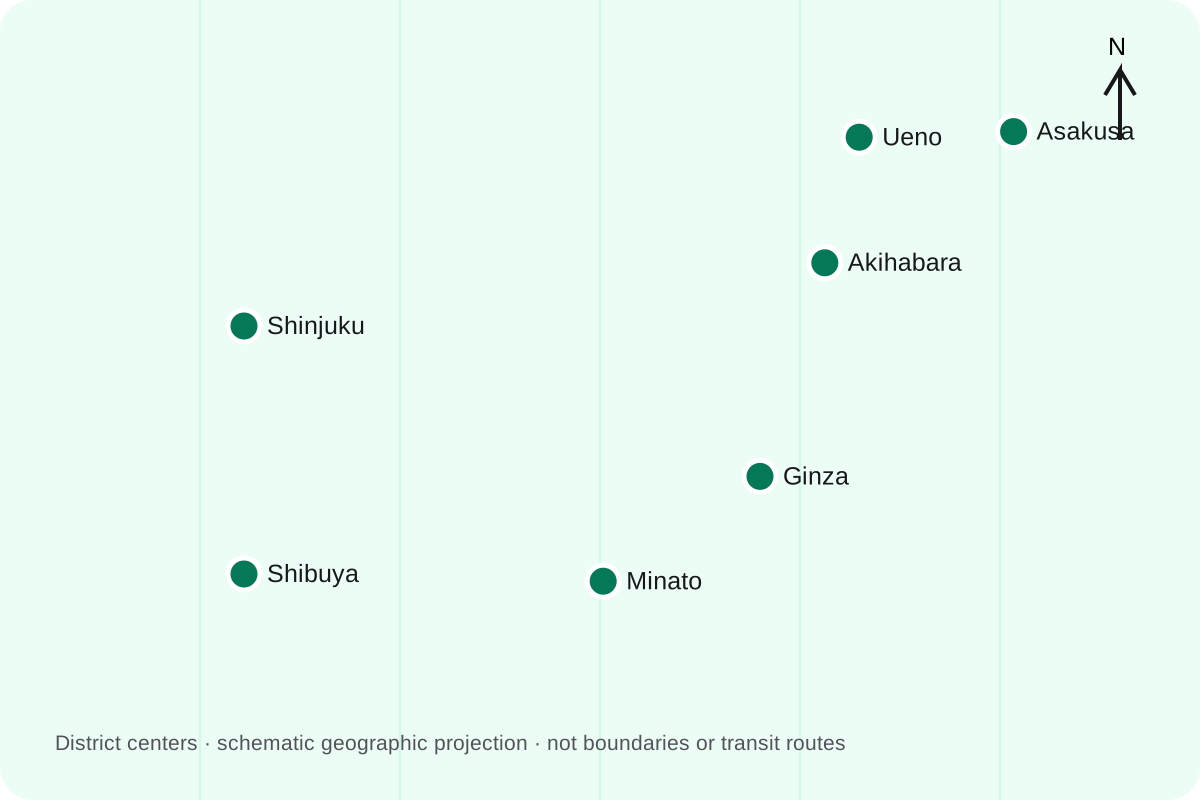
For a December night, Skytree and Tokyo Tower are the reliable indoor or sheltered views. Shibuya Sky is the one that can be cancelled by wind after you have planned the evening around it. Book the refund rules you can live with, and read them on the operator page. Our ticket guides quote those official tables and link to the operators. The map below uses the existing 3D districts so you can see where each deck sits before you add a second one.
Tokyo Skytree ticketsTokyo Tower ticketsShibuya Sky ticketsCompare the three decks
Explore Tokyo districts
Minato
Tokyo Tower’s Main Deck is listed open until 23:00, last entry 22:30, which makes it the late viewpoint. Zojo-ji’s gate is the dusk photo at the foot of the tower, and it does not require a deck ticket.
Select a place with the keyboard
Some links on this page are affiliate links. If you book through them, PlayableTrip may earn a small commission at no extra cost to you. How we make money.
Compare more Tokyo attraction tickets
Tokyo-wide attraction listings from Tiqets. Check the actual attraction, date and ticket inclusions before booking.
Browse Tokyo attractions on TiqetsFrequently asked questions
How cold is Tokyo in December?
JMA’s 1991–2020 normals for Tokyo put the December mean at 7.7°C, with a mean daily high of 12.0°C and a mean daily low of 3.8°C. That is an average, not the forecast for your week.
Does it snow in Tokyo in December?
The JMA monthly normals for Tokyo show a December snow-day figure of 0.6 and no monthly snowpack in the snowfall-depth columns. Snow is possible and not the typical condition. Check the forecast.
Are winter illuminations free?
The Marunouchi and Tokyo Dome City displays documented by GO TOKYO for the 2025–26 season were listed as free to walk through. Dates for the next winter were not confirmed on those pages when we checked on October 11, 2026.
Is Tokyo National Museum open at the end of December?
For 2026 the museum is open through December 25, with only two galleries open from December 22 to 25, then closed December 26 through 31. January 1, 2027 hours were not yet set on the museum’s visitor page.
Source & review
Last verified October 11, 2026. Hours, prices, access and closures can change. Check the operator’s site before your visit.
- JMA climatological normals, 1991–2020 (Tokyo mean temperature and precipitation)
- JMA Tokyo monthly normals, including December maximum, minimum, humidity, and sunshine
- GO TOKYO winter illumination guide (updated January 1, 2026)
- GO TOKYO: Marunouchi Illuminations 2025, ended February 15, 2026
- GO TOKYO: Tokyo Dome City illuminations 2025–26, ended March 1, 2026
- Tokyo National Museum hours and 2026 year-end closure
- Shibuya Sky
- Tokyo Skytree
- Tokyo Tower